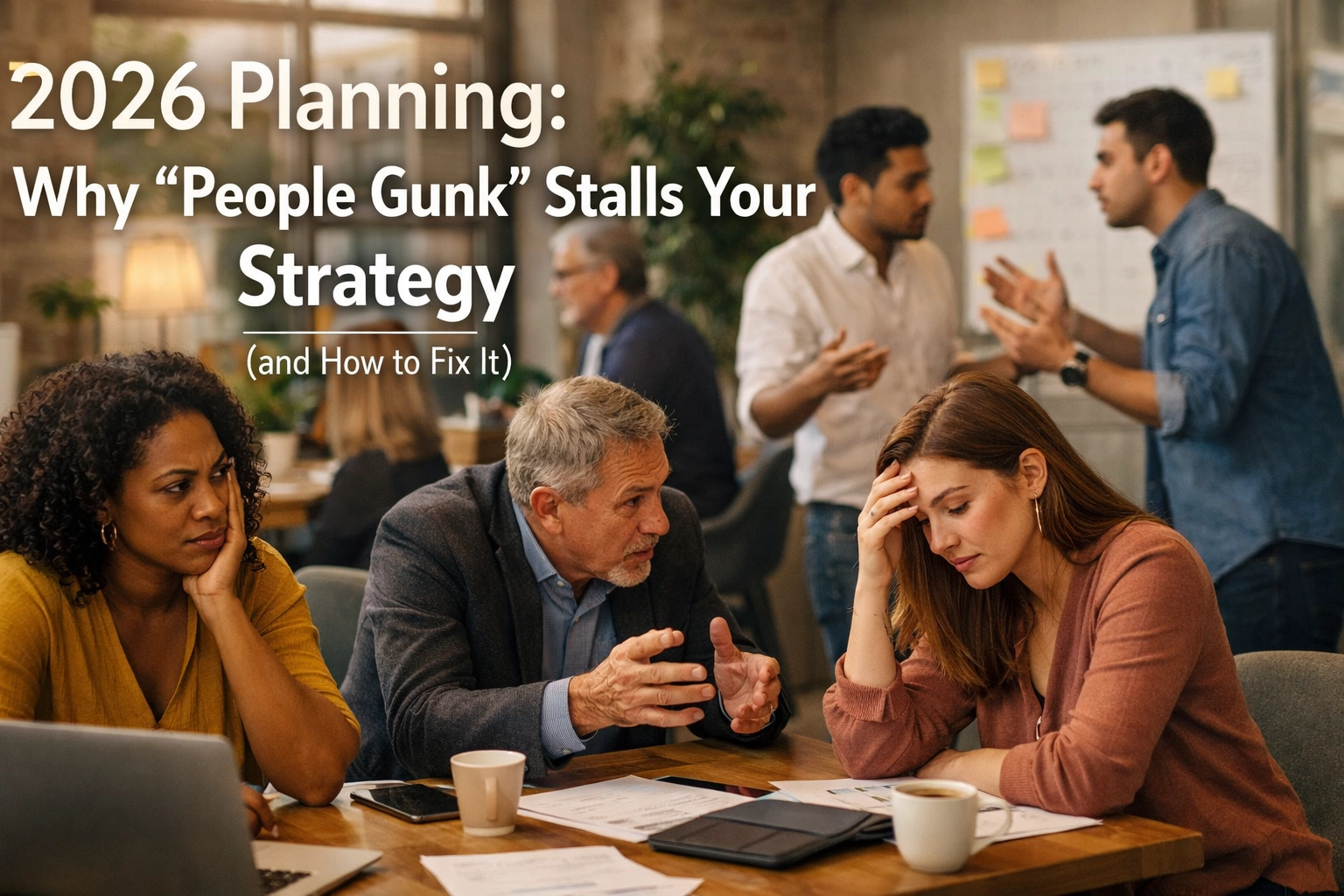
You have the 2026 vision statement printed in a bold, sans-serif font. Your KPIs are neatly tucked into a color-coded spreadsheet. You’ve even mapped out a RACI chart so everyone knows exactly who is Responsible, Accountable, Consulted, and Informed. On paper, your strategy is a masterpiece. It’s logical, it’s ambitious, and it’s ready to launch your organization into its most successful year yet.
But as you look around the table, you feel a nagging sense of unease. You see the subtle eye-rolls when a specific deadline is mentioned. You notice the "quiet" silos where information goes to die. You hear the "yes" in the meeting that sounds suspiciously like a "no" in the hallway.
What you’re sensing isn't a failure of logic; it’s the buildup of "People Gunk."
At Raleigh Consulting Group, we’ve spent the last 47 years helping leaders navigate the messy, human side of business. We’ve seen brilliant strategies crumble not because the math was wrong, but because the people tasked with executing them were stuck in a cycle of hidden friction and personality clashes. If you want 2026 to be the year your strategy actually sticks, you have to stop looking at the spreadsheet and start looking at the people behind it.
The Perfection of the Spreadsheet vs. The Messiness of Reality
Does your current planning process feel like a math exercise? It’s tempting to believe that if we just get the "what" right, the targets, the budgets, the timelines, the "how" will take care of itself. We treat our organizations like machines: pull this lever, and that output occurs.
However, organizations aren't machines; they are ecosystems of human beings. When you ignore the human element, "People Gunk" begins to accumulate. This "gunk" is the invisible friction that slows down decision-making, drains energy, and turns a high-speed strategy into a sluggish crawl.
People Gunk manifests as:
- Hidden agendas: Team members agreeing in public but resisting in private.
- Communication breakdowns: Information being hoarded or misinterpreted.
- Low psychological safety: People are afraid to point out flaws in the plan until it’s too late.
- Misaligned priorities: Different departments pulling in opposite directions because they don't see the "big picture."
Have you ever wondered why a project that looked so simple on the whiteboard ended up months behind schedule? It’s rarely because the team lacked the skill; it’s almost always because they lacked the alignment. Leadership Challenge, by Kouzes and Posner, highlights this with its first of "Five Practices for Exemplary Leadership" – Inspire a Shared Vision.**

47 Years of Navigating Human Hurdles
Experience teaches you things that a textbook can’t. At Raleigh Consulting Group, our strategy is only as good as the relationships that support it. We’ve worked with large and small businesses alike, and the core challenge remains the same: humans are complicated.
We’ve seen leaders try to "policy" their way out of personality clashes. We’ve seen them try to "incentivize" their way out of poor culture. It never works long-term. To fix the "People Gunk," you have to go deeper. You have to understand your team's Behaviour Intelligence. You have to understand how they work and, more importantly, why they do what they do.

Decoding the "How" with DISC
If you want to clear the gunk, you need a common language. One of the most effective tools we use at RCG is the DISC assessment. DISC helps your team understand their behavioral styles, how they respond to challenges, how they communicate, how they respond to pressure, and how they approach tasks.
When you understand that your "High D" (Dominance) manager isn't being rude, they’re just focused on results, the friction decreases. When the "High D" realizes that the "High S" (Steadiness) team member isn't being slow, they’re just ensuring the plan is sustainable, the gunk starts to clear.
How DISC impacts your 2026 planning:
- Dominance (D): These folks want to move fast. They push the strategy forward but might miss the details.
- Influence (I): These are your cheerleaders. They build excitement for the vision but may struggle with follow-through.
- Steadiness (S): These are the stabilizers. They ensure the team stays together, but they might resist sudden changes in the plan.
- Conscientiousness (C): These are your quality controllers. They find the holes in the strategy, which can feel like "negativity" to others, but it's actually vital risk management.
By using Behaviour Intelligence DISC, you move from "Why is he like that?" to "How can we work together more effectively?"
Uncovering the "Why" with Drivers
While DISC explains how we work, Drivers explain why we work. This is the engine under the hood. Two people might have the same DISC profile but be motivated by completely different things.
One person might be driven by a desire for ROI and utility, while another by a desire to help others or to gain personal power. If your 2026 strategy only appeals to one type of driver, you’re going to leave half your team unmotivated.
Strategic alignment occurs when individual motivations are mapped to organizational goals. When people see how the company’s success helps them fulfill their own core drivers, the "People Gunk" evaporates. They aren't just doing a job anymore; they are on a mission.

From Spreadsheet to Reality: Creating Impactful Alignment
So, how do you move from a "gunked up" planning process to one that actually delivers? It requires a shift in focus. Instead of just reviewing the numbers, you must facilitate intentional alignment sessions.
True alignment isn't just about everyone saying "okay." It’s about creating a space where conflict can be healthy and where every voice is heard. This is where team building becomes a strategic necessity rather than an optional retreat.
Actionable steps to clear the gunk today:
- Acknowledge the Friction: Start your planning sessions by asking, "Where are we stepping on each other's toes?"
- Assess Your Team: Use tools like DISC and 360 Feedback to get an objective view of the team dynamics. You can learn more about this in our guide on how 360-degree feedback works.
- Define Rules of Engagement: How will we handle disagreements? How will we ensure everyone stays in their lane without building silos?
- Connect Strategy to Purpose: Remind everyone why this 2026 goal matters.
Why Facilitation is the Secret Ingredient
It’s incredibly difficult to clear the "People Gunk" when you are part of the team. As a leader, you have your own DISC profile, your own Drivers, and your own biases. This is why professional facilitation is so powerful.
A neutral third party from Raleigh Consulting Group doesn't just "run a meeting." We act as an objective mirror. We identify the "gunk" you’ve become accustomed to. We ask the uncomfortable questions that team members might be afraid to ask each other.
Our facilitation services are designed to bridge the gap between your brilliant 2026 ideas and the actual human beings who have to make them happen. We help you build an agile mindset that allows your team to pivot when the market shifts, without the internal friction that usually follows.

Don't Let 'People Gunk' Define Your 2026
You’ve put too much work into your 2026 planning to let it be derailed by avoidable interpersonal conflict. The most successful organizations in the next decade won't just be the ones with the best technology or the most capital; they will be the ones that have mastered the "people side" of the equation.
If you are tired of watching great strategies stall out, it’s time to take a different approach. Let's get the gunk out of the system and get your team moving in the same direction with clarity, energy, and impact.
Ready to align your team for the year ahead?
Whether you need a one-day alignment session or a long-term executive coaching engagement, we are here to help you navigate the human hurdles of leadership.
Book a Facilitation Session with Raleigh Consulting Group Today
Let’s turn your 2026 strategy into reality. Together, we can clear the friction and focus on what really matters: your growth.
Want to learn more about our philosophy? Check out who we are or dive into our library of leadership books to start your journey toward more effective team management.